

To choose the correct Four Row Tapered Roller Bearing for heavy-duty industrial lines, you need to know how loads move, how the lines will be used, and the performance requirements. Four rows of curved rollers in these special bearings give them a horizontal and axial load capacity that is almost three times higher than that of single-row designs. For the best performance in tough industrial settings, engineers in steel manufacturing, rolling mills, and precision machinery must look at things like bearing size ranges (120-1320mm inner diameter), material composition (GCr15/GCr15SiMn/G20Cr2Ni4A), cage configurations, and mounting requirements.
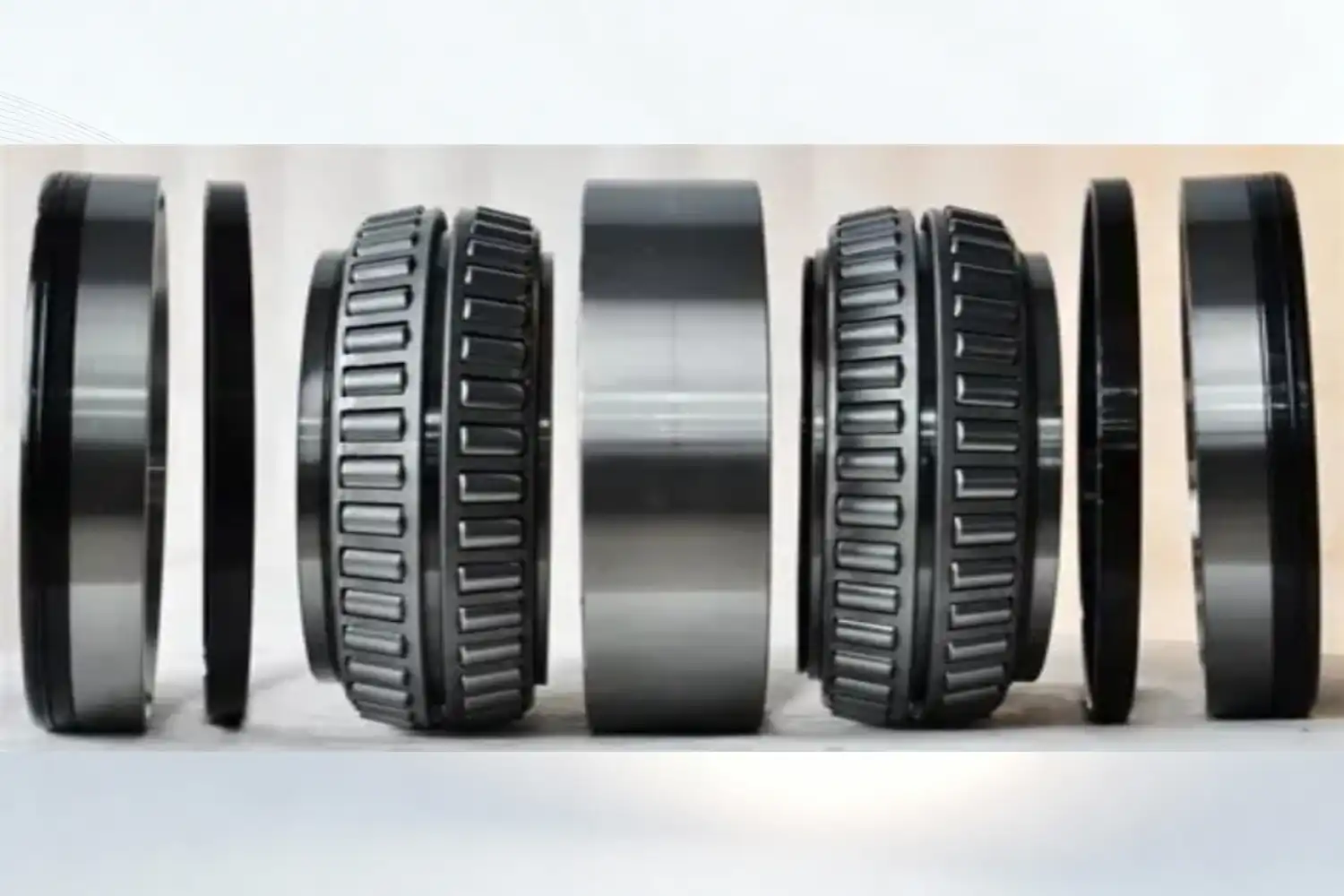
Understanding Four-Row Tapered Roller Bearing Design Fundamentals
The physics behind four-row tapered roller bearings is a big step forward in the field of heavy-duty bearings. In contrast to standard single-row designs, these bearings have four separate rows of curved rolling elements that are set up to spread the load across the bearing system as evenly as possible. This way of thinking about design makes it possible to handle axial and rotational loads better while keeping precise shaft support. The tapering inner ring shape and the rolling parts work together to make the best contact angles. Carefully designed cage systems keep each roller perfectly aligned. For normal uses, these are usually steel-pressed cages, while pin-type designs are used for bigger installs. Because this setup lowers friction and increases load capacity, these bearings are very important to the working of rolling mills. The choice of material is very important for how well a bearing works. High-quality steel alloys, such as GCr15 and G20Cr2Ni4A, are very durable and can be used in harsh circumstances. Specialized heat treatments are used on these materials to make them as hard and resistant to wear as possible. This gives bearings a longer life in tough industrial settings.
Critical Load Calculations and Capacity Requirements
For heavy machinery uses, accurate load estimates are needed to keep bearings from breaking down too soon. When both radial and axial forces act on the bearing system at the same time, four row tapered roller bearings do a great job. Because of its unique four-row form, these forces are spread out over many touch places, which greatly reduces stress loads. Engineers have to look at changing load rates based on how the system is actually used. When choosing a bearing, things like spinning speed, changes in temperature, and shock loads are taken into account. When it comes to safety, four-row designs are better than single-row designs because they can spread loads more evenly. This is especially true in cogging mills and hot rolling processes. Misalignment is a regular problem in big machinery setups that should be taken into account when figuring out the load capacity. The strong design of four-row versions lets small shaft deflections happen without affecting performance, making them reliable for use in harsh industrial settings.
Material Properties and Performance Characteristics
The limits of performance in heavy-duty bearing uses are set by advanced metals. GCr15SiMn steel is better at resisting wear under the repeated pressure situations that are common in rolling mills. The combination of silicon and manganese makes the material harder while keeping its shape during heat treatment.G20Cr2Ni4A alloy steel is very tough and can be used for purposes that need to handle heavy loads. The chromium-nickel presence makes microstructures with small particles that stop cracks from spreading when there is a lot of stress. This material choice is necessary for bearings that work in steel factories where shock loads happen all the time. Surface cleaning methods make bearings last even longer. Specialized strengthening methods make surface shapes that are better at reducing friction and increasing wear resistance. When compared to normal setups, these methods make bearings last a lot longer, which saves money in big industrial settings.
Installation Techniques and Mounting Considerations
When you put a bearing in the right way, it will work perfectly for as long as it is used. Four-row tapered roller bearings usually use clearance fits with roll necks, which makes mounting and dismounting them easier for repair work. This way of designing cuts down on downtime while still providing solid wheel support. When installing bearings, they need to be lined up correctly, which requires careful attention. If the orientation is off by more than the allowed range, the load will be spread unevenly across the four rows, which could cause them to break before they should. Specialized adjustment tools help get things exactly where they need to be for the best performance. Integration of the lubrication system is a key part of good setups. The right choice of lube and transport method will make sure that the film thickness between the rolling elements and raceways is just right. Temperature affects the thickness of the lube that is needed. This is especially true in hot rolling mills where high temperatures make it hard for regular lubrication systems to work.
Application-Specific Selection Criteria
Rolling mill uses have special problems that affect the choice of bearings. Extreme temperatures are used in hot rolling, and accuracy and stable dimensions are needed for cold rolling. Four row tapered roller bearings can meet all of these different needs by choosing the right materials and internal design. When installing a pigging mill, you need bearings that can handle heavy pressure loads during the first steps of working steel. The strong four-row design evenly spreads contact forces, stopping stress buildups in one area that could weaken the bearing's integrity. For these kinds of uses, special solutions that fit their unique needs are often needed. When working with big spinning machines that are subject to dynamic forces, vibration protection is very important. Four-row layouts are naturally stable, so they dampen vibrations better than other bearing designs. This makes sure that the equipment runs smoothly and lasts longer.
Maintenance Strategies and Life Optimization
Predictive maintenance systems try to get the most out of bearings while reducing the number of unexpected breakdowns. Vibration tracking systems find early warning signs of bearing wear, which lets changes happen before they cause major problems. Four-row tapered roller bearings have clear diagnostic signs that make it easier to keep an eye on their health. Maintenance procedures for lubrication have a direct effect on how long a bearing lasts. Oil research done on a regular basis shows levels of pollution and degrading patterns that affect how often the oil needs to be replaced. When filter systems are set up correctly, they keep bearing surfaces safe from the rough particles that are common in heavy industrial settings. Monitoring temperature can tell you a lot about the state of bearings and how they are loaded. High temperatures usually mean that there are problems with greasing or too much load, which need quick attention. Modern tracking systems give information in real time that lets you plan ahead for repair.
Quality Standards and Performance Verification
Four Row Tapered Roller Bearing works in difficult situations depends on how precisely it was manufactured. Controlling the dimensional tolerances of complex machinery parts makes sure that they fit and work right. Advanced measuring systems check important factors like the shape of the raceway, the roundness of the rollers, and the accuracy of the cage's dimensions. Protocols for testing make sure that bearings work well in realistic working circumstances. Testing for fatigue shows the maximum load that can be put on something, and changing temperatures checks that the dimensions stay the same. These thorough testing methods make sure that bearings meet strict industry standards before they are used. Quality control tools make it possible to track products all the way through the production process. Getting ISO9001 certification shows that you are committed to regular quality, and ISO14001 certification talks about how to handle the environment. With these certificates, you can be sure that the bearings will work and that the production process will be consistent.
Conclusion
Selecting the optimal four row tapered roller bearing requires careful evaluation of load requirements, operating conditions, and application-specific challenges. These advanced bearing designs provide superior performance in heavy-duty applications through enhanced load distribution, robust material properties, and precision manufacturing. Success depends on proper selection criteria, installation procedures, and maintenance strategies that maximize bearing life while ensuring operational reliability. Engineers who understand these critical factors can specify bearing solutions that deliver exceptional performance and value in demanding industrial environments.
Get Expert Four Row Tapered Roller Bearing Solutions from Huigong
Luoyang Huigong Bearing Technology delivers specialized four row tapered roller bearing solutions engineered for heavy-duty industrial applications. Our extensive manufacturing capabilities spanning over 25 years enable custom bearing development for unique operational requirements. With production facilities covering 39,330 square meters and advanced testing equipment, including CMM systems and metallographic analysis tools, we ensure every bearing meets stringent quality standards. Our technical team understands the complex challenges facing engineers in steel manufacturing and precision machinery applications. We provide comprehensive bearing selection support, helping optimize performance while reducingthe total cost of ownership. As a trusted Four Row Tapered Roller Bearing supplier, we maintain inventory across the complete size range from 120mm to 1320mm inner diameter configurations. Ready to discuss your specific bearing requirements? Our engineering team stands ready to provide detailed technical consultation and custom solutions for your heavy-duty applications. Contact us at sale@chg-bearing.com to explore how Huigong's advanced bearing technology can enhance your operational performance and reliability.
References
1. Harris, T.A., Kotzalas, M.N. "Advanced Concepts of Bearing Technology: Rolling Bearing Analysis, Fifth Edition." CRC Press, Taylor & Francis Group, 2007.
2. Hamrock, B.J., Schmid, S.R., Jacobson, B.O. "Fundamentals of Fluid Film Lubrication, Second Edition." Marcel Dekker Inc., 2004.
3. ISO 281:2007, "Rolling bearings -- Dynamic load ratings and rating life." International Organization for Standardization, Geneva, Switzerland, 2007.
4. Warda, B., Chudzik, A. "Effect of Ring Misalignment on the Fatigue Life of Four Row Tapered Roller Bearings." Journal of Tribology, ASME Transactions, Vol. 138, 2016.
5. Palmgren, A. "Ball and Roller Bearing Engineering, Third Edition." SKF Industries Inc., Philadelphia, 1959.
6. ANSI/ABMA Standard 19.1-1994, "Tapered Roller Bearings, Radial - Boundary Dimensions and Series Designations." American Bearing Manufacturers Association, Washington D.C., 1994.