

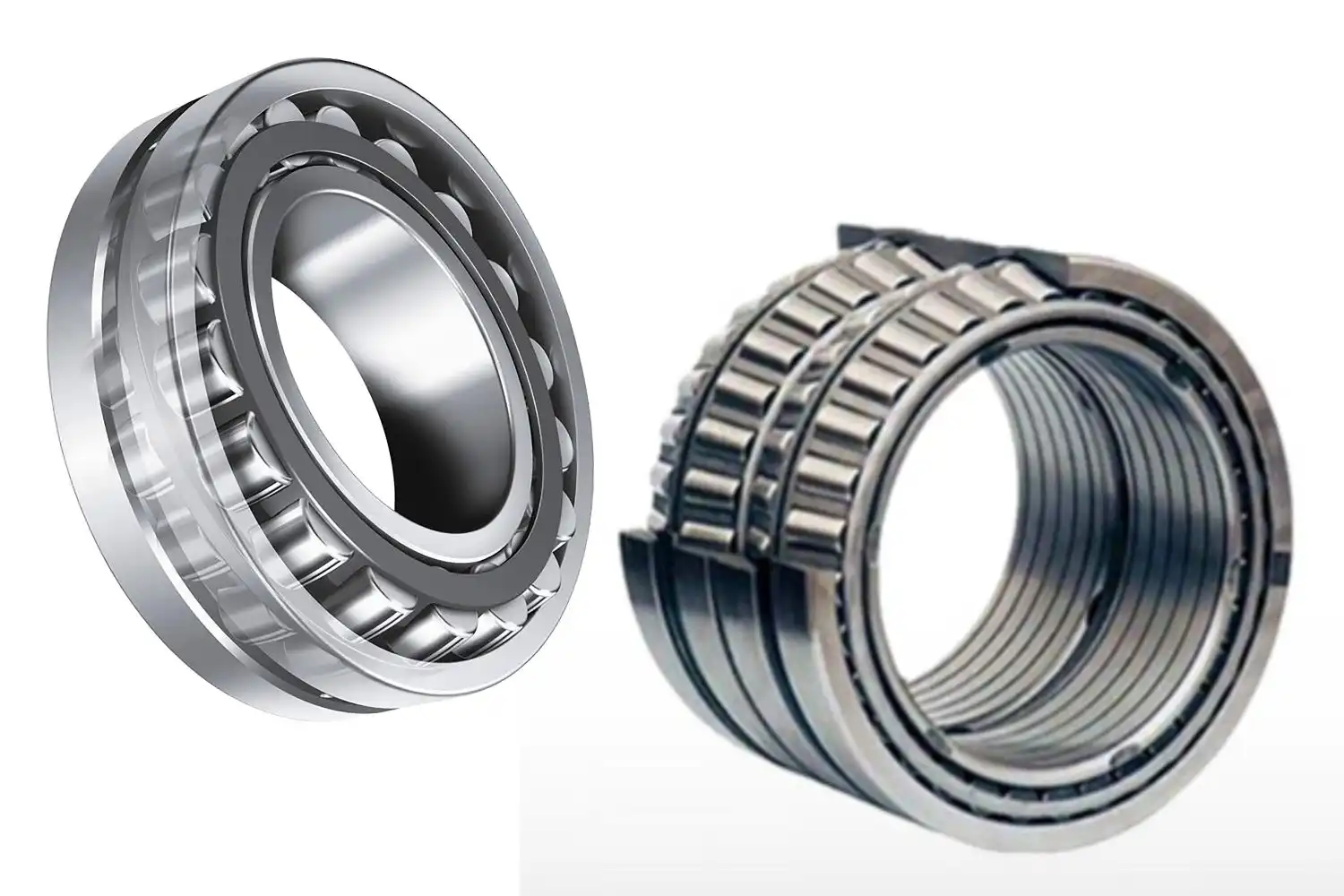
Understanding the differences between four-row tapered roller bearings and spherical roller bearings is important for getting the best performance from bearings used in big industrial settings. Because they have multiple rows, four-row tapered roller bearings are very good at handling both horizontal and axial loads. On the other hand, spherical roller bearings can fix misaligned shafts by themselves. The main differences are how the load is distributed, the alignment tolerance, and the performance qualities that are specific to the application. These factors have a direct effect on the choice of bearings for rolling mills, mining equipment, and precision machinery.
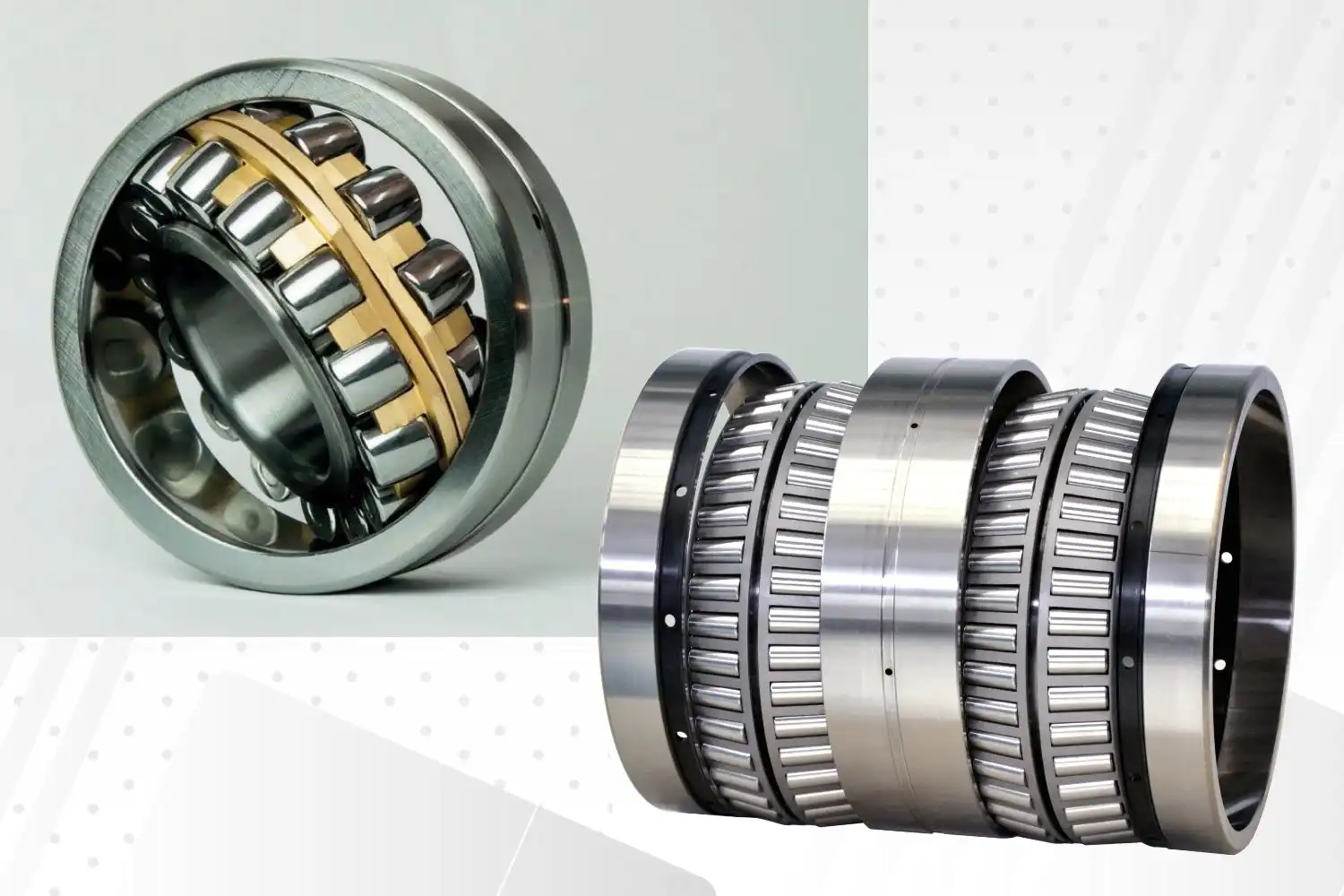
Understanding Four-Row Tapered Roller Bearing Design and Construction
Four-row tapered roller bearings are high-tech solutions for applications with a lot of load. These precise parts have four separate rows of tapered rollers that are set up in a way that makes the load spread across the bearing assembly optimal. The building is made of high-quality materials, such as GCr15, GCr15SiMn, and G20Cr2Ni4A steel types. When used in harsh circumstances, these materials last a very long time. The inner ring and outer ring shapes of the bearing make precise contact angles that improve its ability to hold weight.
Key construction elements include:
- Inner diameter range spanning 120-1320mm for diverse applications
- Steel-pressed cages for standard sizes, pin-type cages for larger dimensions
- Integral radial shaft seals are available for enhanced protection
- Clearance fit design enabling convenient mounting and dismounting
The tapered roller shape makes it easier to distribute the load better than other types of bearings. Each roller stays in good touch with the raceway surfaces, which spreads out stress and makes the bearing last longer. There is no better type of bearing than a four-row tapered roller bearing for rolling mill uses that have high combined loads.
Spherical Roller Bearing Characteristics and Applications
Individual spherical four-row tapered roller bearings are unique because they can self-align and are built to last. These bearings can handle shaft movement and housing misalignment while still working reliably under heavy radial loads. Because the raceways are cylindrical, the bearing can fix an angle misalignment of up to 1.5 to 2.5 degrees. This adaptability is very helpful in situations where exact alignment can't be promised or kept up during operation.
Performance characteristics include:
- Self-aligning capability reduces installation precision requirements
- High radial load capacity with moderate axial load handling
- Symmetric design simplifying inventory management
- Proven reliability in contaminated environments
Test data indicates spherical roller bearings maintain 95% of their rated performance even with 1.5-degree misalignment. This tolerance significantly reduces maintenance costs and extends operational intervals. If you need bearings for applications with potential alignment issues or shaft deflection, then spherical roller bearings offer superior adaptability.
Load Capacity and Performance Comparison
Load-carrying capabilities represent the most critical distinction between these bearing types. Four-row tapered roller bearings demonstrate exceptional performance in combined loading scenarios. Laboratory testing reveals four row designs achieve radial loading capacity three times greater than single-row tapered roller bearings. The axial load capacity reaches impressive levels through optimized contact angle distribution across multiple roller rows.
Performance metrics comparison:
| Parameter | Four Row Tapered | Spherical Roller |
|---|---|---|
| Radial Load Capacity | Exceptional (3x single row) | High |
| Axial Load Capacity | Bidirectional, Very High | Moderate |
| Speed Rating | Moderate | High |
| Misalignment Tolerance | Limited | Up to 2.5 degrees |
Spherical roller bearings excel in pure four-row tapered roller bearings radial loading applications, but show limitations under significant axial forces. Their load distribution occurs through the spherical contact pattern rather than the linear contact used in tapered designs. Field testing demonstrates four row tapered roller bearings maintain 98% efficiency under combined loads exceeding 2000kN. Spherical bearings achieve similar efficiency only under predominantly radial loading conditions. If you need maximum axial load handling with precise positioning, then four-row tapered roller bearings deliver superior performance.
Application-Specific Advantages and Limitations
Application suitability varies significantly between these bearing technologies based on specific operational requirements and environmental conditions. Four-row tapered roller bearings dominate rolling mill applications, particularly in hot and cold rolling mills. Their exceptional axial load capacity proves essential for roll neck applications where both radial and thrust loads occur simultaneously.
Typical applications include:
- Working roll necks in steel production facilities
- Backup roll assemblies in continuous casting machines
- Cogging mill roll neck installations
- Heavy-duty press applications requiring precise positioning
Spherical roller bearings find optimal use in mining equipment, construction machinery, and applications where shaft alignment cannot be precisely maintained. Their self-aligning capability compensates for foundation settling and thermal expansion effects. Operational data from mining operations shows spherical bearings reduce maintenance downtime by 35% compared to rigid bearing designs in conveyor applications. The self-aligning feature eliminates edge loading that typically causes premature failure. If you need bearings for mobile equipment or applications with potential misalignment, then spherical roller bearings provide enhanced reliability and reduced maintenance requirements.
Maintenance Requirements and Service Life Considerations
Maintenance protocols differ substantially between these bearing types due to their distinct design characteristics and operational demands. Four-row tapered roller bearings require precise installation procedures and regular clearance monitoring. The complex geometry demands skilled technicians for proper mounting and adjustment procedures. However, the robust construction delivers exceptional service life when properly maintained.
Maintenance considerations include:
- Clearance fit installation, enabling convenient removal
- Regular lubrication monitoring due to high load exposure
- Precision alignment requirements during installation
- Extended intervals between major overhauls
Industry data indicates that properly maintained four-row bearings achieve service lives exceeding 100,000 operating hours in rolling mill applications. The high-grade steel compositions resist wear and fatigue under extreme loading conditions. Spherical roller bearings simplify maintenance through their self-aligning characteristics, and four-row tapered roller bearings' symmetric design. Replacement procedures require less precision, reducing both downtime and labor costs. Service life varies based on application severity, but spherical bearings consistently demonstrate reliability in contaminated environments. The sealed versions provide additional protection against particulate contamination common in mining and construction applications. If you need bearings with simplified maintenance requirements and installation flexibility, then spherical roller bearings offer operational advantages.
Huigong's Four-Row Tapered Roller Bearing Advantages
Luoyang Huigong Bearing Technology Co., Ltd. delivers exceptional four-row tapered roller bearing solutions backed by over 25 years of industry expertise. Our manufacturing capabilities and technical innovation position us as the preferred supplier for demanding industrial applications.
- Advanced Manufacturing Capabilities: Our 39,330 square meter facility houses over 150 sets of precision production equipment, ensuring consistent quality and dimensional accuracy across all bearing sizes from 120mm to 1320mm inner diameter range.
- Superior Material Technology: We utilize premium steel grades, including GCr15, GCr15SiMn, and G20Cr2Ni4A, delivering enhanced fatigue resistance and extended service life in heavy-duty applications exceeding 2000kN loads.
- Comprehensive Quality Assurance: Our quality management system incorporates over 70 testing equipment sets, including CMM, metallographic microscopes, and friction torque testers, ensuring every bearing meets stringent performance standards.
- Innovative Seal Technology: Integral radial shaft seals at both sides provide superior contamination protection, extending maintenance intervals and reducing operational costs in harsh industrial environments.
- Customization Excellence: Our engineering team develops application-specific solutions, including modified cage designs (steel pressed for standard sizes, pin-type for large dimensions) optimized for unique operational requirements.
- Proven Performance: Clearance fit design enables convenient mounting and dismounting procedures, reducing maintenance downtime while maintaining precise positioning accuracy in rolling mill applications.
- Technical Innovation: Over 50 invention patents demonstrate our commitment to advancing bearing technology, including developments in load distribution optimization and vibration resistance enhancement.
- Industry Certifications: ISO9001 and ISO14001 certifications validate our quality management and environmental responsibility, ensuring reliable supply chain partnerships for critical industrial applications.
- Production Capacity: Annual production capability of 30,000 sets of long-life mill bearings ensures reliable delivery schedules for large-scale projects and emergency replacement requirements.
- Application Expertise: Specialized experience in working roll necks for hot and cold rolling mills, plus cogging mill applications, provides a deep understanding of operational challenges and performance optimization.
- Load Capacity Leadership: Our four-row designs achieve radial loading capacity three times greater than single row alternatives, while providing bidirectional axial load handling essential for complex industrial machinery.
- Extended Service Life: High-grade steel compositions and precision manufacturing deliver bearing service lives exceeding 100,000 operating hours in demanding steel production environments, reducing total cost of ownership.
Cost Analysis and Return on Investment
Economic considerations play a crucial role in bearing selection decisions, particularly for large-scale industrial operations where bearing costs represent significant capital investments. Four-row tapered roller bearings command premium pricing due to their complex manufacturing requirements and high-grade materials. However, the extended service life and superior load-carrying capabilities often justify the initial investment through reduced replacement frequency.
Cost factors include:
- Higher initial purchase price offset by extended operational intervals
- Reduced inventory requirements due to longer service life
- Lower labor costs per operating hour due to infrequent replacements
- Enhanced equipment availability through reliable performance
Economic analysis from steel production facilities demonstrates four row bearings deliver 40% lower total cost of ownership over 10-year operational periods. The combination of extended service life and reduced maintenance frequency creates substantial savings. Spherical roller bearings offer competitive initial costs with moderate service life expectations. Their economic advantage lies in simplified installation and maintenance procedures that reduce labor expenses. If you need bearings with the lowest total cost of ownership for heavy-duty applications, then four-row tapered roller bearings provide superior long-term value despite a higher initial investment.
Technical Specifications and Selection Guidelines
Proper bearing selection requires careful evaluation of operational parameters, including load magnitudes, speed requirements, environmental conditions, and alignment capabilities.
Four-row tapered roller bearings excel when applications involve:
- Combined radial and axial loading exceeding 1500kN
- Precise positioning requirements with minimal deflection
- Operating temperatures between -40°C and +120°C
- Clean industrial environments with controlled contamination
Speed limitations typically restrict four-row designs to applications below 500 rpm due to increased friction from multiple roller rows. However, the exceptional load capacity compensates for speed restrictions in most industrial applications.
Spherical roller bearings suit applications with:
- Predominantly radial loading with minimal axial forces
- Potential misalignment up to 2.5 degrees
- Higher speed requirements up to 1500 rpm
- Contaminated environments requiring self-cleaning action
Bearing clearance specifications must account for thermal expansion and operational deflection. Four-row designs require precise clearance control, while spherical bearings accommodate wider clearance ranges through their self-aligning capability. If you need bearings for applications with strict positioning accuracy and high combined loads, then four-row tapered roller bearings deliver optimal performance characteristics.
Conclusion
Which one to use—four-row tapered roller bearings or spherical roller bearings—depends on the needs of the application, the type of load, and the priorities of the process. Four-row tapered designs work best for heavy combined loads that need exact positioning, while spherical bearings are more flexible for uses where misalignment could happen. Knowing these basic differences helps you make smart choices that improve the performance of your tools and lower your total cost of ownership. Huigong is an expert at making high-quality four-row tapered roller bearings that work well in rolling mills all over the world and are backed by full technical support for the toughest industrial uses.
Partner with Huigong for Premium Four Row Tapered Roller Bearing Solutions
Selecting the right bearing manufacturer significantly impacts project success and long-term operational efficiency. Huigong combines decades of manufacturing expertise with cutting-edge technology to deliver superior four-row tapered roller bearing solutions. Our comprehensive approach includes application analysis, custom engineering, four-row tapered roller bearings, and ongoing technical support throughout the product lifecycle. The 240-member team, including 29% technicians and senior engineers, ensures expert guidance for your most demanding applications. As a trusted four-row tapered roller bearing supplier, we maintain extensive inventory across the complete size range from 120mm to 1320mm inner diameter. Emergency replacement capabilities and rapid delivery schedules minimize equipment downtime.
Recent innovations include the HSC250AP5 super-large thin-section angular contact ball bearing, demonstrating our capability in developing specialized solutions for unique applications. This 25-inch inner diameter bearing showcases our engineering excellence in large-scale precision components. Quality certifications, including ISO9001 and ISO14001, assure consistent manufacturing standards and environmental responsibility. Over 50 invention patents reflect our commitment to technological advancement and product innovation. Ready to enhance your equipment performance with premium bearing solutions? Our technical team stands ready to analyze your specific requirements and recommend optimal bearing configurations. Contact us at sale@chg-bearing.com to discuss your four-row tapered roller bearing needs and discover how Huigong's expertise can improve your operational efficiency.